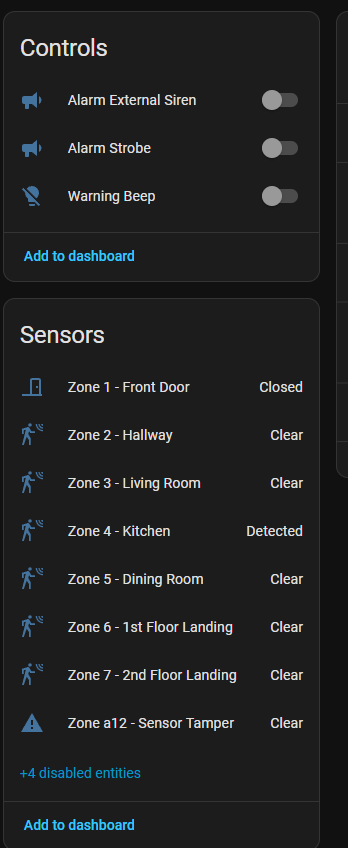
I understand that most (all?) tamper circuits in legacy alarms work by running a current through a complete circuit that “breaks” when devices/sensors are opened. I hope to bring this over to Konnected (Pro) from my existing legacy alarm by repurposing a zone for it. My questions:
Is it as simple as connecting the existing tamper circuit to a zone and setting invert?
The tamper circuit for the siren (I’m in the UK) runs a voltage of 12v (using a separately powered circuit that is constantly on; the trigger is switched). I expect the current to be low but can’t be sure. Is this safe to attach directly to a Konnected zone (I guess using the ground from AUX), or is that asking for trouble? If so, is there a way to use an optocoupler or the like to isolate the circuits?
I’m not as familiar with the UK standards as I am with North America standards, but I’ll share what I know and have learned. Also there are different types of tamper circuits – for inputs (sensors) and for the siren.
Here in North America, tamper-protection for inputs is implemented with End-of-Line resistors on the sensor wires, installed at the end of the line, usually within the door/window frame just underneath the sensor. This creates a known resistance on the loop, when the door is closed, creating three possible states:
Closed - panel measures known resistance (i.e. 2000ohms)
Open - panel measures infinite resistance (circuit is open)
Tamper - somebody shorted the wire loop between the panel and the sensor (0ohms)
There really aren’t any smart home systems that I know of that support tamper states on open/close sensors, so we’ve basically just chosen to ignore this and advise people to remove the resistors if present.
Tamper for sirens usually doesn’t exist in residential systems in North America.
In the UK and Europe, it’s common for residential sirens to have battery backups, and a constant voltage. If a bad guy cuts the power, the siren will detect that and sound the alarm from battery power.
So to answer your question – NO it’s not appropriate to connect the tamper circuit to a zone (12V can damage the inputs), but you CAN (and should) connect it to AUX+ and AUX- which provides a constant 12V supply.
That’s great, thank you. I suppose this would work, but without any tamper protection for the siren? I’m not actually sure why there is a separate tamper terminal for the siren - I presume it’s so that it can communicate a tamper status to the panel (in the case of a cover removal rather than cable cut). I think that means it can be isolated via an optocoupler but I’ll put that in my to-do list for now.
Interesting. Here, wired sensors have 6 wires - 2 for power (wired up in parallel), 2 for sensing (each sensor with its own terminals representing a zone) and 2 more for the tamper circuit - here, all sensors have these wires connected in series before entering the panel. The voltage across this circuit is less than 1V, which I suppose is because of all the round trips its making!
I believe the tamper circuit is just another zone for the panel (albeit one treated in a special way wrt alarm states), so my initial thought was to just treat it as a zone in konnected too. Is there any way to test this safely?
I’m in the UK. I’ve wired the tamper circuit from the sensors (PIRs mainly) in to a spare Zone as you described in your original post. As you say, the tamper wires are wired in series across all sensors before coming back in to the panel. From what I can tell, it’s akin to a continuity test. If there is a break in the series, assume a tamper. However, I have not wired a tamper signal from the Siren, as in my setup this is simply not provided. The tamper circuit of my siren is self-contained, if it detects a tamper it sets off it’s internal siren and strobe itself..
Thank you for the insight. Glad to hear it’s working and will do the same. Some comments for completion:
I believe the “sensor” circuit of PIRs are also “continuity circuits” in that they open when motion is detected, and so need to be inverted. Dis you have to do the same for the tamper zone?
My siren also has a battery backed up self contained tamper circuit that goes off when either the line is cut or the panel is opened. The “tamper return” in this case is to comminicate to the panel that a tamper even has happened, so the alarm can trigger (eg for the internal siren or other alert). Leaving this out means that if the external siren is cut, it would go off, but konnected won’t know. The value in that depends on the threat model I suppose.
For #1, I’m using mode: Input_pullup for all zones including tamper.
telling ESPHome to configure that GPIO as an input and to enable the internal pull-up resistor.
This mean the pin will read HIGH (1) when not connected (floating), and will read LOW (0) when connected to GND (for example, when a pir is triggered.).
For #2. Don’t think the alarm panel has a 12v input switch. You might want to look at another ESP device with that option and send an event to Alarm panel to trigger the internal siren.
Thanks for the input_pullup tip. Is there any documentation on that? I thought invert would have been enough.
And no, it doesn’t have a 12v input - I’d have to use some kind of relay, probably an optocoupler and wire it to a zone. As I said… it’ll be on the to do list ;).
EDIT: oh, it seems that the Konnected import does this for me anyway:
Just to close this off, I have both zone tamper and the siren’s “tamper return” working, the latter via an Optoisolator connected to a second tamper zone (I could have put it in series with the zone tampers but thought I’d keep it separate for now).